电机功率
与任何电气设备一样,电机也需要消耗一定的电流和功率才能运转。电机将部分输入功率转换为旋转轴的功率,这部分功率就是输出功率。从能量而非速度和扭矩的角度来考虑电机,可以让我们更容易计算如何使用电机,并为选择最佳应用齿轮比提供工具。
什么是电机功率?
从根本上说,功率是指在给定时间内传递的能量。实际上,这意味着功率就是你能从电机中获得多少 “能量”。电机的输出功率随负载的多少而变化,但不会随电机齿轮比的变化而变化。这意味着,自由旋转的 1:1 马达与自由旋转的 100:1 马达输出的功率相同(忽略摩擦差异),但实际速度和扭矩不同。输出功率与速度乘以扭矩成正比,因此在使用齿轮箱改变速度和扭矩时,输出功率必须保持不变。
另一个信息是电机的 输入 功率,虽然并不总是那么有用。电机的输入功率是指电机消耗功率的瓦数,等于发送到电机的电压乘以电机消耗的电流。电机的效率并非 100%,因此要获得一定的输出功率,通常需要输入功率的两倍甚至三倍。例如,一个标准的 FTC® 电机仅产生 29 瓦的输出功率就会消耗高达 65 瓦的功率。
峰值功率和电机曲线
In order to figure out how much power your motor will be consuming or outputting, it’s helpful to reference a motor curve. These are data sheets that plot the motor’s output speed, output torque, output power, and efficiency all on one graph. Every FTC legal motor except the Core Hex has been dyno tested, and their data are below. It is safe to assume other non-current limited motors (such as servos) follow similarly-shaped curves, although with different speed, torque, and power outputs.
自由转速(每分钟) |
自由电流 (A) |
最大功率(瓦) |
堵转扭矩 (N*m) |
堵转电流 (A) |
|
|---|---|---|---|---|---|
goBILDA(MATRIX) |
5900 |
0.3 |
29 |
0.19 |
11 |
NeveRest |
5500 |
0.4 |
26 |
0.17 |
9.8 |
REV Core Hex[1] |
125 |
0.2 |
10 |
3.2 |
4.4 |
REV HD Hex |
6000 |
0.3 |
28 |
0.18 |
11 |
TorqueNado |
5900 |
0.2 |
26 |
0.17 |
9.8 |
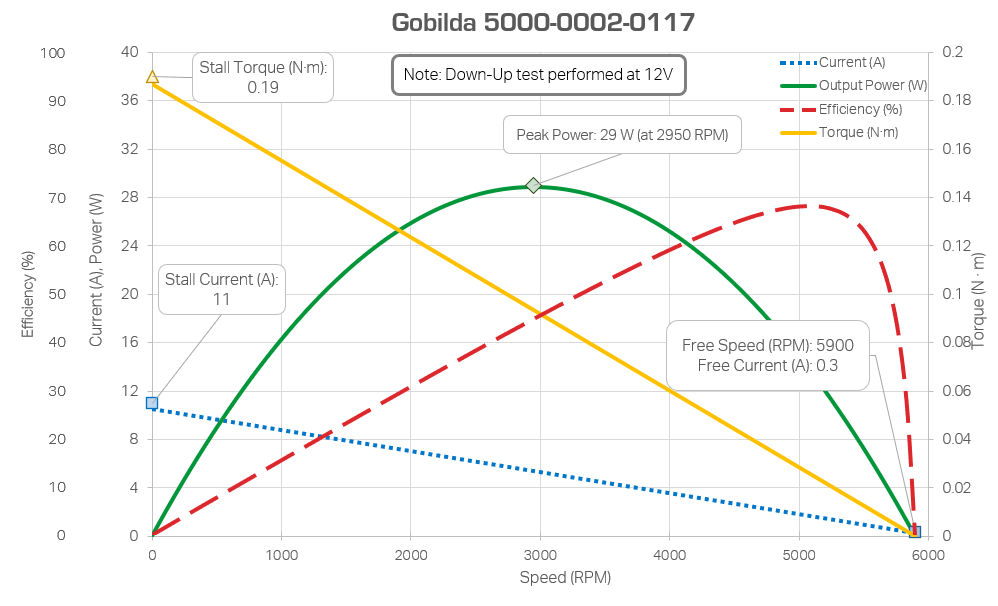
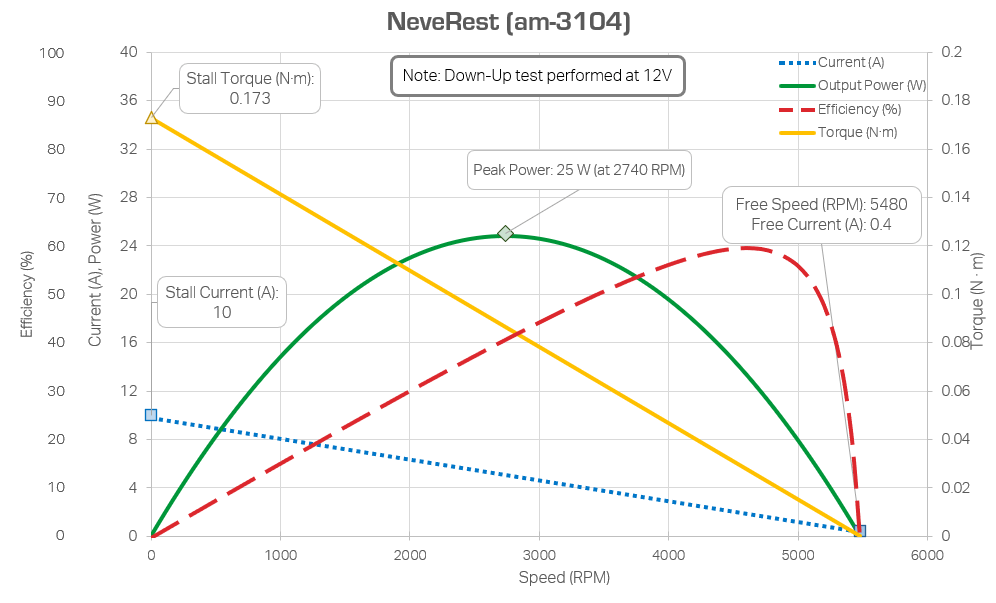


电机曲线表示电机在 12 V 电压下(相当于在软件中将电机功率设置为 1),轴承受不同程度的负载。如图所示,电机输出的功率并不是恒定的,而是一直上升到大约 50%的负载,然后再次下降。50% 负载时的这一点称为电机的 峰值功率输出 ,所有 FTC 合法电机的峰值功率输出点(50% 负载)都类似。
The varying power of a motor means that speed and torque output do not change linearly when more load is applied onto the axle. Counterintuitively, placing 50% stall load on a motor doesn’t halve its speed, but will rather reduce it to slightly above 50% speed. Similarly, placing more than 50% load on a motor will cause the speed to fall faster than linearly.
In addition, you can see that efficiency rises as speed goes up. This means, if current draw is a concern, one should always be running their motors with loads below 50% of their stall torque. These two properties of a motor, the peak power output being 50% of the stall torque and the efficiency of a motor being higher the lower the load is, guide the selection of the gear ratio of a motor. Ideally, gear ratios should be chosen such that the stall torque is twice the average torque load on the motor, and should skew towards providing more torque than needed rather than less.
电流消耗说明
在查看电机曲线时,您可能会发现 FTC 电机的堵转电流可高达每个电机 11 安培。在保险丝熔断之前,FTC 电池只能提供 20 安培的电流输出。不过,即使没有达到 20 安培的限制,过大的电流也会导致其他电机感觉迟钝或反应迟钝。应注意确保两个以上的电机不会同时堵转。
备注
在处理机械传动系统时,您或许可以忽略这一点,因为它们通常会在电机实际达到堵转电流之前打滑。但是,如果在牵引传动系统上使用极低的齿轮比或超过 4 个电机,就会超过 FTC 电池的电流限制。
电机可能会产生 “瞬时电流”,即在极短的时间内产生大量电流。这种情况通常发生在电机开始运转或瞬间加载负载时。虽然瞬时电流一般不会导致保险丝熔断,但会引起其他问题,例如,如果瞬时电流是由电机产生的,则会导致控制迟缓;如果瞬态电流是由舵机产生的,则会导致低电压(goBILDA 超高速舵机偶尔会出现这种情况)。